

How to Get a Job With No Experience (Step-by-Step Guide)
Breaking into the job market without experience can feel like a paradox: employers want experience, but you need a job to get experience. This is one of the most persistent barriers facing early-career professionals across both developed and emerging markets.
In the United States, many entry-level roles still request prior experience, while in fast-growing markets like Nigeria, competition for junior roles continues to intensify as more graduates enter the workforce each year. The result is the same everywhere: capable candidates get filtered out before they ever get a chance to prove themselves.
But here’s the reality most people miss—this isn’t an impossible barrier. It’s a signaling problem.
Employers aren’t truly looking for “experience” in the traditional sense. They’re looking for evidence. Once you understand how to create and present that evidence, the path to getting hired becomes much clearer.
This guide walks you through a practical, step-by-step system to land your first role—even if you’re starting from zero.
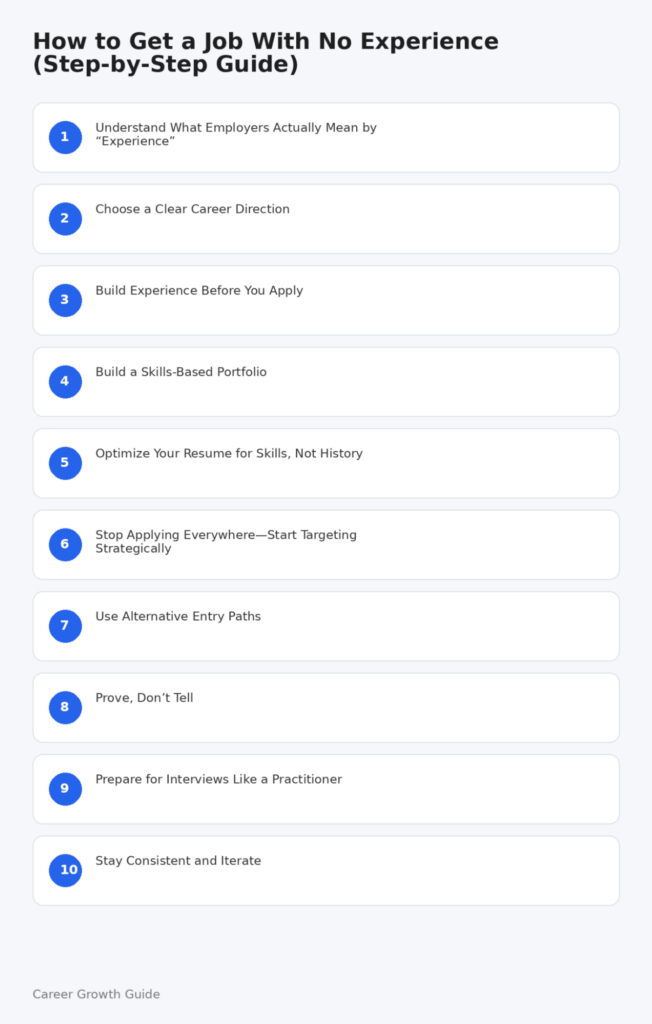
Step 1: Understand What Employers Actually Mean by “Experience”
Most candidates interpret “experience” as formal employment. Employers don’t.
What hiring managers actually want is proof that you can do the job. That includes:
- Evidence of skill application
- Proof of execution
- Signals of reliability and consistency
This is why non-traditional work counts more than most people think. Freelance projects, volunteer work, personal builds, and structured programs all demonstrate capability when framed correctly.
For example, someone who has built a simple data dashboard using public datasets is often more compelling than someone who has only completed coursework. The difference is tangible proof.
This shift toward proof is part of a broader move toward skills-based hiring. If you want a deeper breakdown of this trend, you’ll find it helpful to explore how employers are rethinking credentials in Why Skills-Based Hiring Is Replacing Traditional Resumes, where the focus is increasingly on demonstrated ability rather than job titles.
Platforms like Kijana are built around this exact insight—helping candidates generate validated, structured work experience that employers can actually trust.
Step 2: Choose a Clear Career Direction
One of the most common mistakes early-career candidates make is applying to everything. It feels productive, but it actually weakens your positioning.
When you apply broadly, your profile becomes generic. Employers struggle to understand what you’re actually good at.
Instead, narrow your focus.
Choose one or two target roles and reverse-engineer them. Look at job descriptions and identify the core skills required. Then align your efforts toward building those specific capabilities.
For instance, if you’re targeting marketing roles, your focus might include content creation, basic SEO, and analytics. If you’re leaning toward data roles, tools like Excel, SQL, and dashboarding platforms become more relevant. Product roles might emphasize user research, wireframing, and communication.
Clarity creates momentum. It also makes your applications more compelling because everything you present reinforces a single narrative.
If you’re still unsure which direction to take, exploring options in Best Entry-Level Jobs That Don’t Require Experience can help you identify roles that align with your strengths and market demand.
Step 3: Build Experience Before You Apply
This is where most candidates hesitate—but it’s the most important step.
You don’t wait for a job to gain experience. You create it through proactively building or working through case studies, projects, and unpaid or volunteer opportunities.
Employers consistently rank skills like problem-solving, teamwork, and communication above academic performance. That means doing the work matters far more than simply learning about it.
There are several ways to start building experience immediately:
You can work on real-world projects by identifying small business problems and solving them. You can collaborate with peers to simulate team environments. You can contribute to open-source work or create case studies based on real companies.
More structured options also exist. Programs that simulate real work environments or connect you directly with businesses allow you to gain experience that is closer to what employers actually value.
This is where Kijana plays a unique role—sitting at the intersection of education, real work, and hiring. Instead of leaving candidates to guess what counts as “experience,” it provides structured, employer-aligned projects that produce clear, validated outcomes.
If you’re struggling with where to start, it may help to read How To Build Experience Without A Job, which breaks down practical ways to generate credible work even before your first hire.
Step 4: Build a Skills-Based Portfolio
A resume tells employers what you claim. A portfolio shows them what you’ve actually done.
For candidates without traditional experience, a portfolio is often the single most powerful asset you can build.
Strong portfolios don’t just showcase work—they tell a story. Each project should clearly explain the problem, the approach you took, and the outcome you achieved.
For example, instead of saying you’re interested in marketing, you could present a project where you created a content strategy for a small brand and tracked engagement improvements over a defined period. Even if the project is self-initiated, the structure demonstrates real thinking and execution.
Over time, your portfolio becomes a body of evidence that reduces uncertainty for employers. It answers the question they’re really asking: “Can this person do the job?”
Step 5: Optimize Your Resume for Skills, Not History
When you don’t have formal work experience, your resume needs to shift from a timeline of jobs to a showcase of capability.
Instead of emphasizing where you’ve worked, emphasize what you’ve built and what you can do.
A strong early-career resume typically includes a clear summary of your direction and skills, followed by a projects section that highlights your most relevant work. Skills should be listed in a way that aligns directly with the roles you’re targeting, while education plays a supporting role rather than the centerpiece.
The goal is simple: make it easy for a recruiter to quickly see your relevance.
If you want a deeper dive into structuring this effectively, How To Make Your Job Application Stand Out (Even With No Experience) provides a more detailed breakdown of how to position yourself competitively.
Step 6: Stop Applying Everywhere—Start Targeting Strategically
Mass applying feels like progress, but it’s usually inefficient.
When you send out dozens or hundreds of generic applications, you’re competing at the highest level of noise. Recruiters receive large volumes of similar profiles, and without differentiation, your chances of standing out are low.
Targeted applications, on the other hand, significantly increase your chances.
When you apply strategically, you tailor your resume, reference relevant projects, and sometimes even reach out directly to hiring managers. This shifts you from being one of many applicants to a candidate with context and intent.
If you want to understand how to break out of the “application pile,” you’ll benefit from reading How To Get Noticed By Employers Without Applying Everywhere, which explores alternative strategies that improve visibility and response rates.
Step 7: Use Alternative Entry Paths
Traditional job boards are not the only way into the workforce—and often not the most effective for candidates without experience.
Alternative pathways can dramatically improve your chances by reducing competition and increasing direct exposure to employers.
These include project-based talent platforms, apprenticeships, referrals, and contract work. Each of these pathways allows you to demonstrate your abilities in a more practical context rather than relying solely on credentials.
Kijana is particularly relevant here because it combines structured experience with direct employer access. Instead of applying blindly, candidates can participate in real projects that serve as both experience-building and evaluation mechanisms.
This reduces hiring risk for employers and creates a clearer pathway for candidates.
Step 8: Prove, Don’t Tell
One of the biggest mistakes candidates make is relying on adjectives instead of evidence.
Saying that you’re “hardworking” or “motivated” unfortunately doesn’t carry much weight without proof. Employers hear these claims constantly. However, what stands out is demonstration.
Completed projects, measurable outcomes, and consistent work patterns all signal reliability in ways that words cannot. The more you can show tangible results, the easier it becomes for an employer to trust your potential.
This is ultimately the core of getting hired without experience: replacing assumptions with proof.
Step 9: Prepare for Interviews Like a Practitioner
Once you start getting interviews, the focus shifts from getting noticed to proving depth.
Early-career candidates often make the mistake of preparing generic answers instead of deeply understanding their own work.
Your projects become your strongest assets in interviews. You should be able to explain the problem you tackled, the decisions you made, the challenges you faced, and the results you achieved.
A simple but effective framework is the Situation–Task–Action–Result approach. It helps structure your responses in a way that is clear and compelling.
The goal is to show how you think, not just what you’ve done.
Step 10: Stay Consistent and Iterate
Job searching is not a one-time effort—it’s a system.
The candidates who succeed fastest are the ones who treat it as an iterative process. They track applications, analyze responses, and continuously refine their approach.
If a certain type of application isn’t getting responses, they adjust. If a project isn’t resonating, they improve how it’s presented.
Consistency compounds. Small improvements over time lead to significantly better outcomes.
Key Takeaways
Getting a job without experience is less about luck and more about strategy.
What matters most is understanding that experience is simply proof of ability. Once you focus on creating, documenting, and presenting that proof, the job search becomes much more predictable.
Building before applying, focusing on targeted roles, and using alternative pathways all increase your chances of success. Structured platforms like Kijana accelerate this process by aligning experience creation directly with what employers value.
Final Thought
The job market isn’t broken—it’s evolving.
Employers are moving toward skills-based hiring because it reduces uncertainty and improves outcomes. Candidates who adapt to this shift—by creating real work, building portfolios, and demonstrating capability—position themselves far more effectively.
If you want a structured, practical way to build experience and connect it directly to hiring opportunities, exploring the Kijana platform can help you move from learning to earning faster, with clearer signals that employers trust.


Leave a Reply